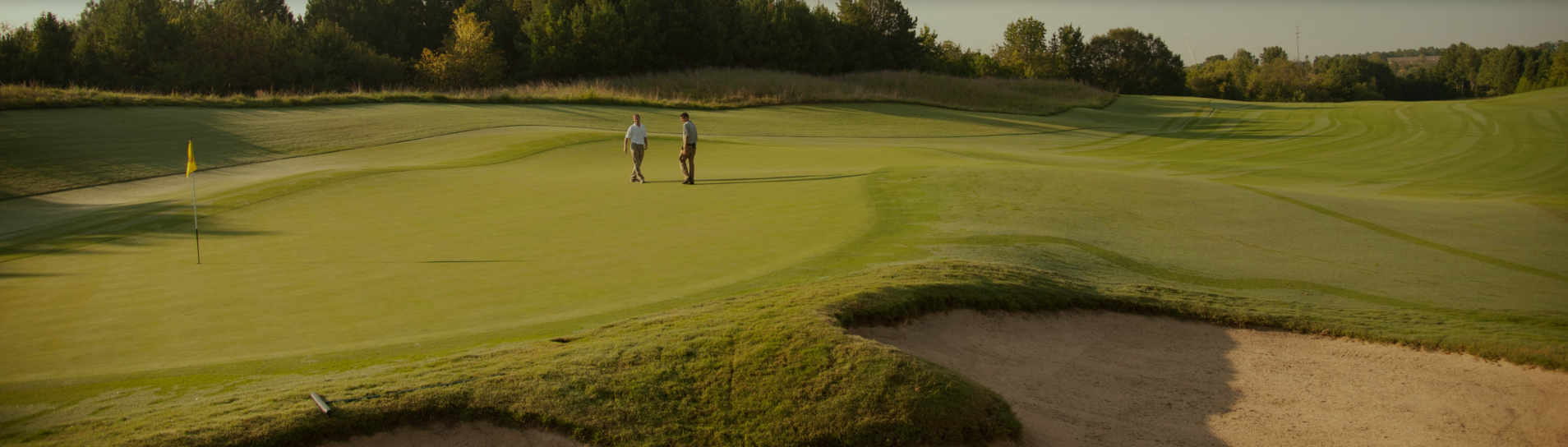
Evolution of the golf course superintendent
Origins of the Game
Golf's introduction to Scotland (between 1424 and 1457) probably came through the merchantmen that sailed into the great harbors on the east coast. Golf was so popular in the 15th century that the 14th parliament of King James III decreed on March 6, 1457 that "fute ball (soccer) and golf be utterly cryitdune," and "nocht to be usit" because the game interfered with archery, an essential element in the defense of the realm.
When the invention of gunpowder at the end of the 15th century reduced the importance of archery, golf again became popular. The Scottish and English paintings and sketches from the early 18th century show golfers playing with maintained fairways and greens, which implies that the work of greenkeeping was well established at that time.
The Royal and Ancient Golf Society of St. Andrews was formed in 1754 and formalized the game by creating a small number of basic rules. In its most rudimentary form, the game consisted of a course, implements (clubs) and a ball. The balls and implements were fairly standard, but the courses varied significantly depending upon rainfall, wind, variety of grass, land features and the presence of grazing animals (the first lawnmowers).
The Early Greenkeeper
The Royal Burgess Golfing Society minutes indicated that in 1774, a boy was engaged as "our cady" and considered the first "greenkeeper" with a remuneration of six shillings per quarter year and a suit of clothes. From 1809 to 1820, a person was employed with the title of clubmaker and officer, as well as assistant in keeping the green. However, in 1866 a council made up of two members of each of five area clubs was appointed to take charge of the green and pay jointly a person "to make holes, look after the flags and mend the turf." A motion was carried that a professional golfer be employed as a servant of the club and the entire charge of the course be entrusted to him. Tom Morris was introduced and his duties explained.
Morris would keep the putting greens in good order, repair them when necessary, and make new holes. He would be allowed one man's labor for two days a week and it would be understood that he was to work under the supervision of the green committee. The newly appointed chief of the links was paid 50 pounds per year and 20 pounds for the upkeep of the links. Although Morris would retire in 1903 after 40 years as greenkeeper, the basics of some of his maintenance practices are still employed today.
As the popularity of the game increased, the rules became more formalized and so did maintenance of the course. And just as the game itself changed, so did the role of those in charge of the playing field. Maintaining a golf course in excellent playing condition while permitting continuous use by golfers in weather that changed seasonally and unexpectedly, demanded knowledge of turfgrass and effective management methods.
Technology, Research, Education, Community
Just as technology has had an impact on the playing equipment, golf course maintenance has been subject to technological advancements. Automatic, satellite-controlled watering systems have allowed superintendents to use water resources more efficiently, while improving conditions for golfers. Equipment such as triplex mowers, verticutters, aerators and lasers have positively affected the playing surface while causing little, if any, down time for facilities.
University and privately funded research have resulted in better turfgrass cultivars, environmental-friendly maintenance practices and improved golf course designs. The result is that golf courses are better conditioned and can better withstand the effects of weather, traffic and disease than a few decades ago. Turfgrass research was limited until the 1920s when the USGA Green Section was established for that purpose. By the 1960s, most states were conducting turfgrass research. It was also during this time of impressive growth that the occupational title of "golf course superintendent" began to replace the term "greenkeeper."
Advances in education have had a great impact on the professional growth of golf course superintendents. Until the 1950s, it was common for the superintendent to spend 90 percent of his/her time performing maintenance duties. Today, that figure is nearer to 35 percent as budgeting, scheduling, personnel, research, design and planning activities each command attention. In order to perform those duties, aspiring superintendents could no longer rely solely on serving an apprenticeship as a stepping stone to the top position. Colleges and universities began offering golf course management curriculums featuring classes in agronomy, business management and communication. The first vocational course for greenkeepers was introduced in 1927 by the University of Massachusetts, which followed shortly with a two-year course of study. In 1957, a two-year course in turfgrass management was started at Penn State. During the 1960s and 1970s, numerous vocational and university turfgrass programs became available and today more than 100 colleges and universities offer two and/or four-year degrees.
A recent Golf Course Superintendents Association of America (GCSAA) study indicates that 98 percent of golf course superintendents have some post-high school education. Continuing education is virtually a requirement for golf course superintendents in order to perform at a high level. Employees who administer the application of chemicals on a course are trained and licensed by various local, state and/or federal governing bodies.
Entrusted with administering a large portion of a golf facility's budget and managing its most valuable asset, the golf course superintendent has become an integral member of the management team. Many have assumed roles such as director of golf, manager of golf course operations, general manager, etc. As the game and business of golf has grown, so has the recognition of the superintendent as key to the enjoyment of the game and the economic vitality of golf facilities.
"Maintenance is more important to the golfer than design," internationally-respected golf course architect Michael Hurdzan notes. "Given the choice between a well-designed course and a poorly maintained one, or a poorly designed and well-maintained one the golfer will nearly always choose the better maintained. Maintenance often has a greater influence than design on a course's difficulty and speed of play."
Though education, research and technology enhanced the trade, it was the creation of community that elevated the position of the superintendent. The creation of the USGA Green Section in the 1920 and the Golf Course Superintendents Association of America in 1926 provided a means to network and exchange information for the maintenance of golf facilities.
Organizational Structure
Because ownership and management structures differ from facility to facility, the golf course superintendent's role on the organizational chart will vary. As a general rule, the superintendent, the golf professional and the club/restaurant manager are members of the management team. Tenure, experience and expertise may elevate the superintendent to the general manager position, thus adding more administrative responsibility to his/her course management duties.
For golf courses owned and operated by a municipality, the size of bureaucracy can often determine the reporting lines. Often times, members of the management team will report to a community's director of golf operations, who in turn reports to an administrator such as director of parks and recreation. Within this structure, various committees, both oversight and advisory, may work with the management team members. This might include the Parks and Recreation Board, Citizens Advisory Committee, Green Committee, etc.
In a private ownership arrangement, a general manager or president who reports to the ownership typically oversees the management team. This structure is also found in management companies who specialize in golf course facility administration. The corporate structure usually has a management team reporting to a director/general manager who in turn reports to a regional director, who typically interacts with corporate headquarters.
In an equity ownership arrangement, such as a country club, members create various committees with rotating chairpersons to oversee various aspects of the operations. Golf course superintendents generally interact with a green committee and a green chairman that have oversight in course conditioning issues.
The Golf Course Maintenance Team
Just as the management of a golf course will vary from facility to facility, so too does the actual golf course maintenance team. Factors such as type (resort, private, public), number of holes, playing season and budget determine the composition of the staff. Resort and private courses tend to have larger budgets and larger staffs. Golf facilities that are not open year round, or experience a noticeable drop-off in use during the winter months often employ seasonal workers. Superintendents at these courses use this time for budgeting, inventory and continuing education.
The golf course superintendent has knowledge in all aspects of his operation. Depending on budget, his/her staff usually includes a number of specialized technicians. Assistant superintendent(s) manage operations in absence of the head superintendent, and have responsibility for portions of the course (holes 1-9 or 10-18, bunkers, practice areas). At courses with computerized, watering systems, irrigation technicians oversee this process. Upper end courses with considerable floral displays and landscape activities often employ a horticulturist. Trained spray technicians are often included on the staff for the application of chemicals. A vital member of the maintenance staff is the mechanic who oversees motorized equipment. Changes in technology have made this an even more specialized position. Mowing and bunker responsibilities are generally assigned to hourly workers.
The Superintendent Profile
While the golf course superintendent profession has changed over time, it is still largely a combination of art and science. However financial implications and technological advances have changed the position from one of a laborer to resource manager. Today's superintendent must manage labor, time, materials and finances in a manner that is compatible with the environment, meets financial goals and serves the customer. So what kind of person chooses the superintendent profession? Surveys indicate a passion for the game of golf and/or a desire to work with nature or experience an outdoor setting as the reason(s) people pursue the career.
An analysis of golf course superintendents in the United States reveals the average individual earns $73,799. Those who complete a rigorous certification program administered by the Golf Course Superintendents Association of American generally earn higher salaries and have a greater opportunity to advance in the profession or in the administration of their golf facility. It is not unusual for a superintendent to earn in excess of six figures.
(Information gathered from GCSAA archives and Golf Course Management Magazine)
|